Yemeni journalists threatened; war underreported

yjs

In Yemen a humanitarian catastrophe is in the making. The war, which started in March, is getting uglier by the day. Daily air strikes and an air and naval blockade have disrupted normal life completely, caused enormous destruction and left about half of the 26 million Yemenis in need of food and other basic necessities.

We know all this because UN-organizations, humanitarian agencies like MSF and some international news agencies keep informing the world about the tragedy taking place in Yemen. But information is scarce. In fact Yemen has become hard to access for Arab and foreign journalists. Lack of electricity and poorly developed Internet infrastructure are hampering the citizens to use social media as alternative ways of covering the conflict.

The situation in Yemen has been underreported for years, but the current war has exercising journalism almost impossible. Foreign reporters are not allowed into the country since the Saudi-led campaign started. Yemeni journalists face the problem of finding reliable sources in this polarized country and are subjected to violence and mistrust. Saudi’s, their Yemeni allies nor the Houthi’s are open to the idea of independent reporting. All journalists who are not “on their side” are basically treated like enemies.

Last Friday (29th of May) Ali Saleh Sanhan, the manager of Saba News Agency office in Hajja governorate, was kidnapped. According to the Yemeni Journalists Syndicate Sanhan was taken to the Political Security prison in the governorate, a place that was targeted previously by the Saudi-led Arab coalition airstrikes. Ironically the syndicate called on the local and international rights organizations “to pressure the Houthis to find at least safe detention centres or release the detained journalists”. Earlier in May two Yemeni journalists were killed when the coalition bombed the Houthi locations where they were held.

The IFJ (International Federation of Journalists) has urged the Houthi kidnappers to release journalist Ali Saleh Sanhan as soon as possible. For more info see: http://www.ifj.org/nc/news-single-view/backpid/1/article/ifj-and-its-yemeni-union-urge-immediate-release-of-news-agencys-editor/

Yemeni media freedom and human rights at risk

In May 2013 I took part in the celebration of World Press Freedom Day in Sana’a. More interesting than the speeches and panel discussions was the enthusiasm of participating Yemeni journalists. Yemen was witnessing a revolution. Though there were plenty political and social obstacles, practical difficulties and a lot of violence, many young journalists I met were determined to defendtheir important role ofing the public honestly and professionally.

Two years later Yemen’s’ political process has collapsed and fighting continues to rage across the country with Saudi airstrikes targeting Houthi forces. Yemen has become an extreme hostile place for journalists and human rights defenders. This year no celebration of World Press Freedom Day in Yemen. The Gulf Center for Human Rights published a special report on “Yemeni journalists and human rights defenders at risk during wartime, 2-5-2015” (http://www.gc4hr.org/report/view/36)

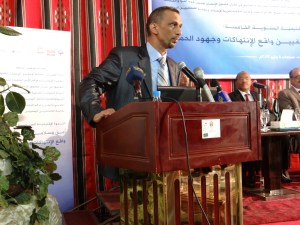
Saeed Thabet addressing Yemeni journalists

The Ministry of Information, which is now run by the Houthis, warned the media that it would take action against any media outlet that opposed their policies, and “that these measures may amount to the closure of any media outlet working to stir up unrest.” And that is exactly what happened. According to the Freedom Foundation for Media Freedom, Rights and Development (http://www.freedomfoundation-yemen.org/en/) the Houthis committed many severe violations and attacks against media since they took control of Sana’a on 21 September 2015. “Press freedom and freedom of expressions faced serious deterioration unprecedented since the start of political pluralism in the country in 1990,” noted the NGO. Only recently (in March 2015) the Houthis stormed several TV channels and blocked many news websites.

But not only the Houthis are violating media freedoms and human rights. Media outlets have strongly sided with either parts of the conflict. The report quotes several experts who point out that most media outlets have constant biases.

The Committee to Protect Journalists called on May 7 for the immediate release of Yemeni journalist Waheed al-Sufi, who has been held for more than a month by unidentified kidnappers. Al-Sufi is the editor-in-chief of the Yemeni weekly newspaper Al-Arabiya and its website, Al-Arabiya Online, according to news reports and his family.