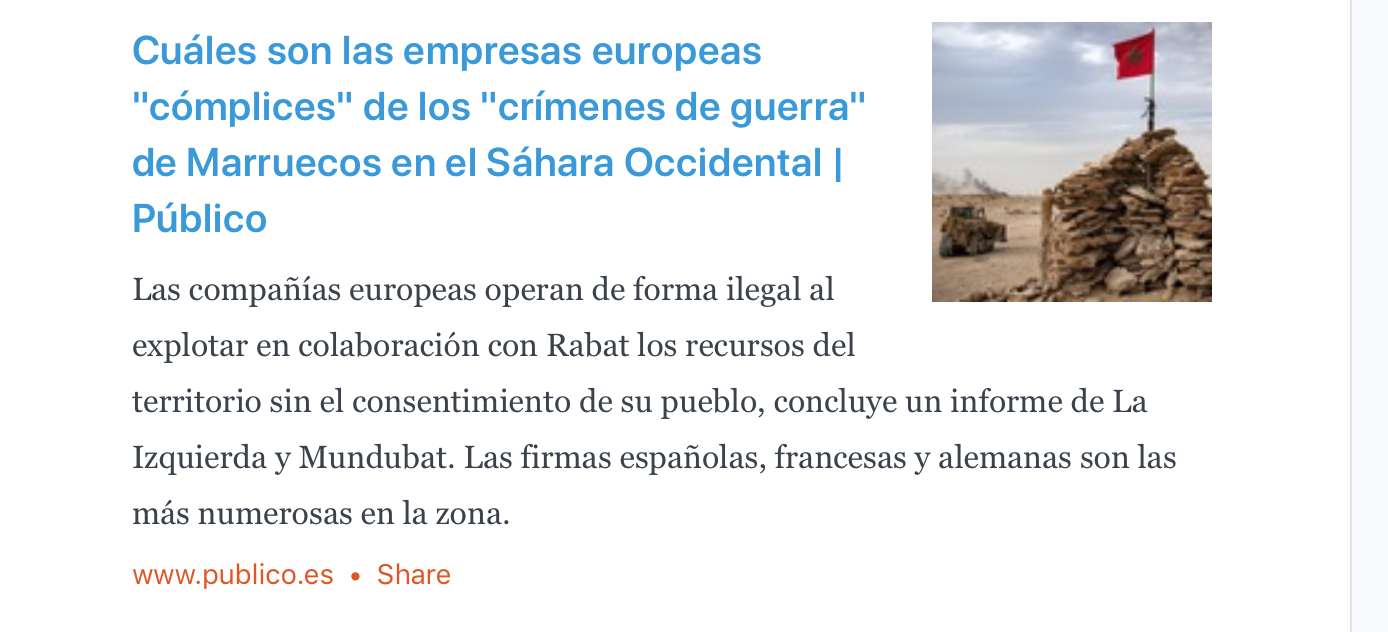
Morocco’s illegal exploitation of Western Sahara’s natural resources is being facilitated through contracts with EU-subsidised companies, according to a new study from The Left in the European Parliament.The study – ‘European companies and violation of International Law in Western Sahara’ – finds that the EU allocates millions of euros in subsidies and aid to Morocco, and to a multitude of European companies (mostly from Spain, France, and Germany) that invest in Western Sahara. This makes the EU a financier and accomplice to an illegal occupation, in contravention of the founding principles of the Union and international law.
The study – ‘European companies and violation of International Law in Western Sahara’ – finds that the EU allocates millions of euros in subsidies and aid to Morocco, and to a multitude of European companies (mostly from Spain, France, and Germany) that invest in Western Sahara. This makes the EU a financier and accomplice to an illegal occupation, in contravention of the founding principles of the Union and international law.
Systematic human rights abuses, police brutality, violations of fundamental rights, the Sahrawi people of Africa’s last colony, Western Sahara, have endured decades of repression at the hands of Moroccan occupying forces. Since 1975 Morocco has attempted to control a territory about the size of the UK using military force to suppress free speech and pro-independence protests. Europe has largely stood by watching a tragedy unfold on its doorstep.
Beyond that there is also the illegal border crossing at Guerguerat which is commonly used by European companies, and may constitute a violation of international law and international humanitarian law. This border crossing point is located on the border with Mauritania. It was opened by Morocco in 2001, even though the United Nations does not recognise any Moroccan sovereignty nor administrative jurisdiction on the territory. The border crossing contravenes the Military Agreement signed by MINURSO in 1997 and 1998 with the Polisario Front and Morocco respectively, as a complement to the peace and cease-fire agreement adopted by the UN Security Council Security Council in 1991.
MEP Miguel Urban will be presenting the report’s findings to the Saharawi Parliament on Sunday.
Speaking ahead of the presentation, Urban said: “The EU and these companies are in flagrant violation of International Law and ‘crimes of colonisation’. The companies involved did not obtain the consent of either the people of Western Sahara or its sole representative, defined by the UN as the Polisario Front.”
“Meanwhile, the EU continues to ignore the constant violations of human rights and International Law that the Moroccan regime carries out on a daily basis.”
“The fate of the people of the Western Sahara are at stake. A people who endure, who just want to live their lives, enjoy basic rights free from violence, to be citizens of their own country. When will Europe stop ignoring these calls for fundamental rights and dignity? When will we stop facilitating repressive regimes and show some respect for the right of the Sahrawi people to self-determination?” Urban concluded.
Key findings:
MOROCCO’S ILLEGAL OCCUPATION
The research confirms the legal consequences of the qualification of Western Sahara as a ‘Non-Self-Governing Territory pending decolonization’: the inalienable right to self-determination. It highlights Morocco’s status as an ‘Occupying Power’, which has control over a territory that it intends to annex illegally by the use of force, as declared by the doctrine of the United Nations and International Law.
EUROPEAN COMPLICITY IN WAR CRIMES
With reference to a 2019 report by the German Bundestag on Moroccan war crimes, the study sets out the case for the appropriation of the natural wealth of the occupied territory of Western Sahara, without the consent of the indigenous population and without the benefits going directly to them, to be treated as a war crime under Art. 47 of the IVth Geneva Convention.
EU FUNDING
The research details how the EU provision of millions of euros in subsidies to European companies that invest in Western Sahara violates international law.
In recent months, North Africa has seen a crescendo of accusations, moves and measures that leave no doubt: Morocco and Algeria are on a collision course. The big question is whether the cold war in the Maghreb will end in an armed conflict. Both neighboring countries have engaged in an arms race and are armed to the teeth.
In August, Algeria broke off diplomatic relations with Morocco. A month later, Algerian airspace was closed to all Moroccan aviation and on November 1, the Europa-Maghreb gas pipeline, which transports Algerian gas through Moroccan territory to Spain, was closed.
The steps were taken after the Moroccan ambassador to the United Nations publicly expressed his support for “the right of self-determination for the heroic people of Kabylie” in July. Earlier, the Algerian authorities had accused Morocco of “sowing discord among the Algerian population” by supporting the MAK, the Mouvement pour l’autodétermination de la Kabylie.
Algiers was not amused (to say the least) when in July an international consortium of investigative journalists revealed in the Pegasus Papers that the Moroccan intelligence service, using Israel’s NSO software, had bugged thousands of Algerian politicians, activists, journalists, diplomats and army officers.
Issue of the Western Sahara is biggest bone of contention between Morocco and Algeria
The biggest bone of contention between Morocco and Algeria, however, is the issue of Western Sahara, an immense desert area the size of the United Kingdom. Morocco has controlled about 85% of the territory of this former Spanish colony since the late 1970s. The Saharawi liberation movement, the Front Polisario, controls the remainder east of the Berm, the 2,700-kilometer-long “defensive wall” Morocco has erected to keep out the Saharawi independence fighters.
Since 1991, when Morocco and the Polisario Front agreed to a United Nations plan to hold a referendum and a ceasefire came into effect, the conflict has been more or less dormant. But that changed at the end of 2020 when the ceasefire, which had lasted for almost thirty years, was broken by the Moroccan army.
The referendum envisaged in the UN plan whereby the Saharawi could exercise their right to self-determination was never held and Morocco established more and more facts on the ground in its “southern provinces”.
The final blow to a diplomatic solution to the conflict was inflicted in December 2020 by US President Donald Trump. In a tweet, he announced that the United States recognized Moroccan sovereignty over Western Sahara. In return, Morocco normalized its diplomatic relations with Israel and awarded a massive $1 billion arms deal to the US. The Americans were going to supply drones and other high-quality military equipment to Morocco.
The Trump deal marked a major diplomatic victory for Morocco. No significant country had so far recognized Moroccan sovereignty over Western Sahara. After all, according to international law, the area still had to be decolonized and the local Saharawi population had to be given a chance to determine its own future.
That, much to Rabat’s anger, also remained the view of European countries and sparked a series of conflicts with Spain, Germany and the EU in 2021. The stance of Morocco’s European allies, who continued to look at the issue of Western Sahara through the prism of international law and did not align themselves with Trump’s recognition of the “Moroccan Sahara”, was seen in Rabat as an insult. “It was like a wedding where none of the friends and acquaintances showed up,” said an observer.
While Trump’s move was criticized by quite a few Democrats and Republicans alike, his recognition of the “Moroccan” Sahara was not reversed after he left the presidency. The Biden administration did not want to jeopardize its relations with either Israel or Morocco.
These relations were apparently more important than the letter of international law and the Saharawi’s right to self-determination.
In addition, a withdrawal of the recognition of the Sahara as Moroccan could open the door to the cancellation of other questionable Trump decisions, such as his recognition of the Israeli sovereignty over the occupied Golan and East Jerusalem.
The formal ties between Morocco and Israel forged by the Trump administration had a number of far-reaching implications, not least for relations between Morocco
and Algeria.
First, it strengthened Morocco’s international diplomatic position, which could now rely on the influential pro-Israel lobby, especially in the United States. The assertive, almost aggressive attitude towards Europe seems to have everything to do with the Moroccan self-awareness supported by the Israel lobby.
Second, and more importantly, the Trump deal launched Israel as a heavyweight player on the North African chessboard, both politically and militarily. The ever-closer cooperation between the Israeli and Moroccan intelligence services is also seen as threatening by Algeria. Israeli Foreign Minister Yair Lapid added fuel to the fire on his first official visit to Morocco this year by strongly criticizing Algeria. According to Lapid, Algeria is dangerously close to Israel’s nemesis Iran. For the Algerians, enough was enough: it was unheard of for an Israeli minister to criticize them from their Arab neighbor Morocco.
The Israeli factor has heightened distrust between Algeria and Morocco and disturbed the precarious status-quo in Algerian-Moroccan relations of recent decades. Those relations have been problematic since Algerian independence in 1962. The neighboring countries fought a short border war in 1963. Moroccan troops invaded Algeria during the “sand war” and attempted to capture parts of Algeria’s western provinces of Bechar and Tindouf.
In the end, the attempt to take a part of “historic Morocco” by force turned out to be a huge political and military blunder. Arab countries and Cuba came to the aid of Algeria and the Algerian population condemned the Moroccan aggression. Morocco’s traditional allies France and the United States also had little understanding for the expansionist adventure of the then young King Hassan II.
This military adventure of Morocco was ultimately based on the same irredentist delusion of Greater Morocco, which would lead to the conflict over the Spanish Sahara in the 1970s. Nationalist leaders such as Allal al-Fassi were not satisfied with the territory of the Kingdom of Morocco as it emerged in 1956 after independence from France. Fassi included the Spanish Sahara, parts of Algeria, Mauritania and Mali in his Greater Morocco.
According to independent historians, it is a myth that the Western Sahara was once part of the sultanate of Morocco. In 1975, the International Court of Justice found that while a number of tribes in the area had historical ties to Morocco, there were no ties of territorial sovereignty between Western Sahara and Morocco.
Mauritania gained independence in 1960, but it was only recognized by Morocco nine years later. Since then, there have been ups and downs in Moroccan Mauritanian relations, not least because Nouakchott recognizes the Sahrawi Arab Democratic Republic, proclaimed by the Front Polisario.
Almost sixty years after the ‘sand war’, it can be concluded that things have never really worked out between Morocco and Algeria. Although there were periods of relative relaxation and even a friendship treaty was signed in 1969, mutual mistrust persisted, and neighbor disputes continued to flare up. The Algerian-Moroccan border has been closed since 1994 and the government-controlled media of both countries never tire of taunting the regime on the other side of the border.
The tension in the North African region has meanwhile led to an increasingly intense arms race. In addition to the United States, Israel and France, Morocco has also placed large military orders in Turkey, including drones. Algeria is a major buyer of Russian, Chinese and German weaponry. It is expected that the strategic marriage of convenience between Morocco and Israel will prompt Algeria to further increase military cooperation with the Russian Federation.
If it really comes to war, it will mostly produce losers. War would further strain the perspectives of young people in the Maghreb and lead to further emigration and brain drain. Already, the geopolitical tension is a pretext to curtail civil liberties, including freedom of expression and press freedom. For example, it is a taboo in the Moroccan media to report critically about the Sahara issue or about the royal family. In Algeria, the Hirak movement, which aims to democratize the Algerian political system, is under heavy pressure.
An armed conflict would be catastrophic for the peoples of the region. Wars have ravaged the economies of Libya, Syria, Iraq and Yemen over the past decade. Morocco and Algeria could then be added to that infamous list of Arab countries.




 Focus on Media Freedom