Ali Lmrabet asks Moroccan prime minister to intervene

In a long letter to prime minister Abdelilah Benkirane, journalist Al Lmrabet asked him to intervene in order to get his Moroccan passport and ID-card. According to Lmrabet the Moroccan authorities refuse to grant him the documents. “If you don’t intervene I will be a ‘sans-papier’ in my own country”, Lmrabet wrote. Lmrabet has been on hunger strike since June 24. He tried for months to get his documents in his city of birth Tetouan.

“Morocco is a state of law,” said Mohamed Aujjar, Morocco’s ambassador to the United Nations in Geneva, insisting the journalist had “every right to contest the administrative decision” not to provide him with a certificate needed to renew his passport. “But you don’t get your papers by staging a hunger strike,” he told the French news agency AFP. Aujjar said that if Lmrabet disagreed with the administrative decision he could challenge it, but not in Geneva.

Lmrabet flatly rejected Aujjar’s suggestion to return to Morocco and pursue the case in court, insisting he would then be stuck in the country with no papers and no possibility to work or leave. He is still in front of the UN’s offices in Geneva pursuing his hunger strike. Remy Pagani, one of the five members of Geneva’s Administratice Council, has written a letter to king Mohammed VI insisting that “Ali could obtain his ID-documents as soon as possible and resume his professional activities in his country, the kingdom of Morocco”.

Ambassador Aujjar denied to Moroccan news agency MAP that there was any legal decision to deprive the journalist from his ID documents. Lmrabet simply could not get his residence permit from the authorities in Tetouan because he was not actually living there. “He could have resorted to a legal procedure if there is a conflict between him and the local administration, like any other citizen”, according to Aujjar, who accused Llmrabet to turn a simple administrative dispute in a political and media campaign against Morocco.

Remains the question why the Moroccan authorities permitted this conflict to get out of hand. Llmrabet is no “ordinary citizen” but a journalist with a long record of confrontations with the Moroccan authorities over human rights and media freedom issues. Putting obstacles in Mr Llmrabet’s return to journalistic activity cannot be explained otherwise –in the Moroccan context- than blunt political insensitivity or a clear red line against the freedom of expression of certain “troublesome” critics.

further reading:

http://www.menara.ma/fr

http://www.demainonline.com

http://www.maghrebemergent.com/actualite/maghrebine/49292-maroc-le-journaliste-ali-lmrabet-a-benkirane-je-suis-un-sans-papier-dans-mon-propre-pays.html

Moroccan journalist Lmrabet on hunger strike

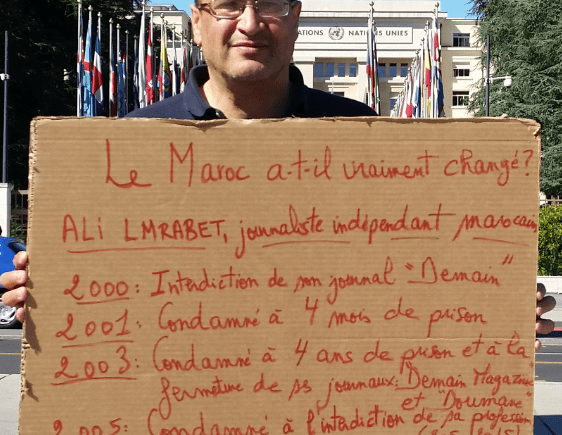
Moroccan journalist Ali Lmrabet has gone on hunger strike Wednesday 24th of June. Lmrabet started a sit-in in front of the UN headquarters in Geneva. Reason of his protest is the refusal by the Moroccan authorities to renew his passport and ID-document. He claims Morocco wants to silence him by turning him into an undocumented person.

Ali Lmrabet on hunger strike in front of the UN Palace of Nations in Geneva

Ali Lmrabet on hunger strike in front of the UN Palace of Nations in Geneva

Earlier Lmrabet, who has dual French and Moroccan nationality, was denied a Moroccan residence certificate in the city of Tetuan, where he was born. Without these documents Lmrabet is not allowed to restart working as a journalist in Morocco and relaunch his two satirical weeklies (one in Arabic and one in French).

This is not Lmrabet’s first hunger strike. Twelve years ago he refused to eat during 50 days. At the time he was in prison, condemned to three years for “insulting” king Mohamed VI. After an international campaign calling for his release he was pardoned in January 2004.

In April 2005 the Moroccan authorities forbade him to exercise the journalistic profession for ten years. This “Berufsverbot” has expired now, but Lmrabet can still not return to journalism is in his home country. For his on-line publication Demain (in French, Spanish and Arabic) see: http://www.demainonline.com/

For an account in French in the Tribune de Geneve see:

http://www.tdg.ch/news/standard/journaliste-marocain-greve-faim/story/17741203?track

Moroccan authorities persecute journalist Ali Lmrabet

Reporters Without Borders is appalled by the way the Moroccan authorities continue to persecute Ali Lmrabet, a satirical newspaper editor who wants to resume publishing newspapers in Morocco now that his ten-year ban on working as journalist has expired.

Ali Lmrabet, who has dual French and Moroccan nationality, is being denied the residence certificate he needs to get a new national ID card and to renew his passport, which expires on 24 June. Without these documents, he cannot move ahead with his declared intention to relaunch his newspapers.

A Reporters Without Borders “Information Hero” and winner of the Reporters Without Borders – Fondation de France Prize in 2003, Lmrabet used to edit Demain and Demain Magazine, publications that were banned in 2003.

Officially, he has been able to resume working as a journalist in Morocco since 11 April. He wasbanned from working for ten years after being convicted of libel.

But the authorities in the northern city of Tétouan have been refusing to give him a residence certificate since 20 April. In a statement issued on 5 May, quoting the interior minister, the Tétouan local administration said it had been established that Lmrabet does not live at the Tétouan address he gave, which is his father’s home.

The Tétouan 2nd district police station had nonetheless issued the certificate to Lmrabet on 22 April, only to demand it back the next day.

According to the information obtained by Reporters Without Borders, Lmrabet possesses all the documentation he needs to get a residence certificate. His address is indeed his father’s and it is the one that appears in his passport.

We are perplexed by the series of bureaucratic obstacles that are being imposed on Ali Lmrabet,” Reporters Without Borders deputy programme director Virginie Dangles said.

It is not clear why the Moroccan authorities are refusing to issue him this certificate. We urge them to provide him with the requested certificate so that he can renew his documents.”

Journalism blocked

The Moroccan Association for Human Rights (AMDH) – which is backing him and whose president testified on his behalf – has asked the Moroccan government to intercede at the national and local level but has not received an answer.

Lmrabet is convinced that the authorities are refusing him a residence certificate in order to prevent him from publishing again.

“I am going to become Morocco’s first undocumented Moroccan,” he told Reporters Without Borders. “I would like to think that, although this government does not like me, it cannot prevent me from having identity papers.”

His lawyer, Lahbib Mohamed Hajji, confirmed that Lmrabet’s papers had the same address as his fathers. Denying him a residence certificate is a violation of his right as a citizen, Hajji said.

Reporters Without Borders has repeatedly phoned and emailed the communication ministry in an attempt to get its version, but the ministry has not as yet responded.

Morocco is ranked 130th out of 180 countries in the 2015 Reporters Without Borders press freedom index.

See also: http://www.demainonline.com